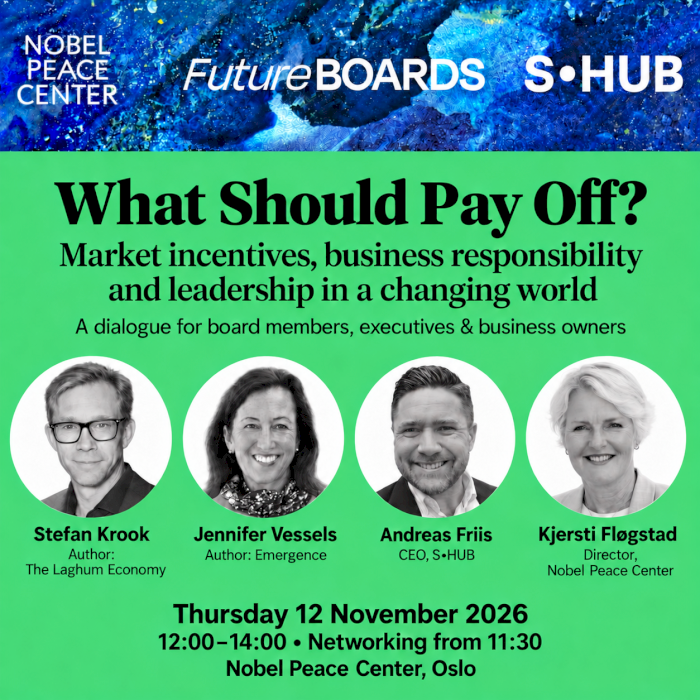
What Should Pay Off?
Thursday 12 November
11:30 – 14:00
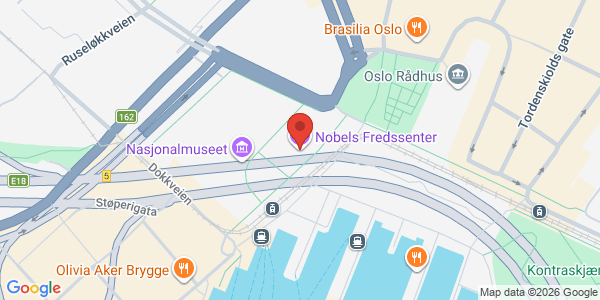
Nobel Peace Center (Nobels Fredssenter)
Nobel Peace Center, Brynjulf Bulls plass, Oslo, Norway
About the event
Organizer: S-HUB
What Should Pay Off?
Rethinking market incentives, business responsibility and leadership in a changing world
What if some of the most important things businesses can do for the future are still the hardest to make profitable? And what does responsible leadership require when both the rules of the economy and the realities of business are changing?
Businesses are expected to deliver competitive returns, embrace new technology and contribute to a healthy society and planet. Yet these ambitions do not always pull in the same direction. Investments that create lasting value can struggle to compete with activities whose wider costs remain outside the balance sheet.
At the same time, AI and changing expectations are challenging established ways of working, organising and leading. Leaders face two connected questions: What should our economic system reward—and how do we build organisations capable of creating that value?
S•HUB, FutureBoards and the Nobel Peace Center invite you to an afternoon of fresh perspectives and open dialogue on market incentives, the responsibilities of business and the leadership needed to turn ambition into action.
Two perspectives. One shared challenge.
Stefan Krook brings an entrepreneur’s perspective on the rules of the economy. In The Laghum Economy, he proposes shifting taxation from labour towards resource consumption, seeking to align market incentives with prosperity within planetary boundaries. His ideas raise practical questions for business leaders, owners and policymakers: What could different incentives unlock? Who would gain, who would bear the costs, and what would a workable transition require?
Jennifer Vessels brings the organisational and human perspective. Drawing on decades of transformation experience and her book Emergence: How Leaders Break Free from Outdated Thinking, she explores how leaders can challenge established assumptions, combine AI with human capabilities and act with purpose under uncertainty.
Andreas Friis connects these perspectives to the strategic choices facing companies today: how to create value now, build relevance for the next decade and contribute to futures worth investing in.
Together, we will explore what businesses can change themselves, where collective action is needed and which changes depend on public policy. Different views and constructive disagreement will be central to the conversation.
Questions we will explore
- What should become more profitable if we want a healthier society and planet?
- Where do today’s incentives reward activities that undermine tomorrow’s prosperity?
- How can companies balance immediate commercial pressures with long-term responsibility?
- What does AI change about value creation—and which human capabilities become more important?
- How can boards and leaders distinguish assumptions worth defending from those they need to reconsider?
- What can we act on now, even when the future remains uncertain?
Programme
11:30–12:00 Arrival and networking
12:00–12:05 Welcome and introduction — Setting the context for the afternoon
12:05–12:35 What Should the Economy Reward? — Stefan Krook on The Laghum Economy, market incentives and prosperity within planetary boundaries
12:35–13:00 Leading Through Emergence — Jennifer Vessels on breaking free from outdated thinking and navigating change with purpose
13:00–13:30 Dialogue: What Can Business Change—and What Must Change Around It? — A moderated conversation with Stefan Krook, Jennifer Vessels and Kjersti Fløgstad, Executive Director of the Nobel Peace Center
13:30-13:45 Audience Q&A — Questions, challenges and implications for action
13:45-14:00 Closing Reflections: From System Change to Strategic Choices — Andreas Friis on value creation today, future relevance and the role of business in shaping the next decade
About the speakers
Stefan Krook
Serial entrepreneur, impact investor and author of The Laghum Economy
Stefan Krook is a Swedish entrepreneur whose ventures include Glocalnet, Kivra and the GoodCause Foundation, which is behind businesses such as GodEl and GodFond. In March 2026 he was named Sweden's EY Entrepreneur Of The Year, and went on to represent Sweden at EY World Entrepreneur Of The Year in Monaco. His work combines commercial entrepreneurship with a commitment to social and environmental value. He is also a Practitioner in Residence at the Stockholm School of Economics.
In The Laghum Economy, Krook sets out a proposal for updating market incentives by shifting taxation from labour towards resource consumption. He brings experience of building companies to the debate about how economic rules could better support innovation, prosperity and a healthy planet.
Jennifer Vessels
CEO of Next Step, transformation leader and author of Emergence
Jennifer Vessels has spent more than two decades helping organisations navigate growth and transformation, bringing together experience from Silicon Valley and Europe. She is CEO of Next Step and founder of the Executive Growth Alliance.
Her book, Emergence: How Leaders Break Free from Outdated Thinking, explores how leaders can move beyond familiar assumptions and navigate uncertainty through purpose, exploration, action, collaboration and empowerment—the elements of her P.E.A.C.E. approach. Her focus is on the practical connection between technology, human capabilities and organisational change.
Kjersti Fløgstad
Executive Director, Nobel Peace Center
Kjersti Fløgstad has led the Nobel Peace Center since 2020. Previously Secretary General of UNICEF Norway, she has also advised businesses on sustainability and corporate responsibility, including at DNB, and chaired CARE Norway. She brings experience spanning business, humanitarian work and leadership.
Andreas Friis
Founder & CEO, S•HUB
Andreas Friis works at the intersection of sustainable business, strategy and ecosystem building. Through S•HUB, he brings leaders, companies and experts together to explore how business can create lasting value and translate ambition into action.
His contribution connects the afternoon’s economic and leadership perspectives to a practical question: How can companies strengthen their performance today while building relevance for the next decade and helping shape positive long-term futures?
Who should attend?
The event is designed for CEOs, CFOs, board members, business owners, investors, strategy and innovation leaders, and sustainability executives. It also welcomes policymakers, researchers and others interested in the relationship between markets, leadership and society.
What you can take away
Expect fresh perspectives on the incentives shaping business decisions, practical questions to bring into your next leadership or board discussion, and opportunities to exchange views with people approaching these challenges from different disciplines.
Join us to challenge assumptions, explore the trade-offs and discuss what responsible, competitive business could look like next.
Tickets
- Standard ticketFree
Registration closes Thursday, 12 November 11:30